
Add Row
Add Element
Metal Green Innovators Logo
update
Metal GreenInnovators
update
Add Element
  • Home
  • Categories
    • Eco Metals
    • Tech Trends
    • Green Processes
    • Innovative Designs
    • Sustainable Materials
    • Industry Insights
    • Future Fabrication
    • Featured Business Profiles
  • All Posts
  • Eco Metals
  • Tech Trends
  • Green Processes
  • Innovative Designs
  • Sustainable Materials
  • Industry Insights
  • Future Fabrication
  • Featured Business Profiles
October 15.2025
2 Minutes Read

Discover How Combination Machines Redefine Sheet Metal Fabrication

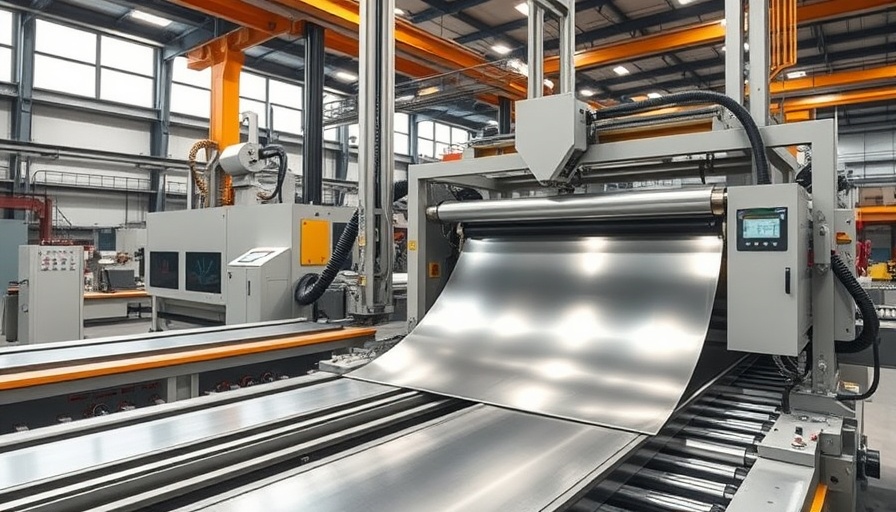
Automated sheet metal fabrication machine in operation.

Revolutionizing Metal Fabrication: The Future is Here

The landscape of sheet metal fabrication is set for a revolution, guided by advancements in automation and energy-efficient technologies. The introduction of combination machines, notably from Prima Power, showcases how effective integration of laser cutting and punching systems can create a seamless fabrication process. The Combi Genius and Combi Sharp are not just machines; they represent a new era of manufacturing versatility and capability.

Unparalleled Flexibility and Efficiency in Production

The Combi Genius is being hailed as the "Swiss Army knife" of fabrication, capable of performing multiple operations such as punching, forming, and laser cutting all in one compact system. This machine's ability to handle aluminum, mild steel, and more—up to 8 mm thick—not only supports diverse manufacturing needs but also enables rapid adaptability to changing market demands. Such flexibility is crucial in today's fast-paced manufacturing environment, where speed and efficiency can determine a company's competitiveness.

Automation as a Catalyst for Change

Automation is no longer a luxury; it is a necessity in sheet metal fabrication. As noted in the field, manufacturers are increasingly turning to automation not merely to cut labor costs, but to enhance throughput. The modular design of the Combi machines allows for easy scalability, accommodating shifts in production without a complete system overhaul. This adaptability to market dynamics exemplifies how automation can revolutionize manufacturing processes.

Environmental Impact: A Sustainable Future

Energy sustainability resonates strongly with today's environmentally conscious manufacturers. The Combi Genius’s EcoPunch technology claims to deliver up to 82% energy savings. By focusing on such energy-efficient solutions, manufacturers can both lower operational costs and reduce their environmental footprint—addressing a growing consumer demand for green practices. Automation and robotics significantly minimize waste and provide higher quality output, supporting an eco-friendly production model.

Smart Software for Smarter Production

Behind the impressive hardware of these machines lies advanced software that enhances operational efficiency. The integration of IIoT platforms not only enables real-time monitoring of equipment but also facilitates better decision-making through data analytics. As these technologies evolve, fabricators will see increased precision, reduced lead times, and overall enhanced performance across the production landscape.

Conclusion: A Call to Embrace the Future of Fabrication

As industries worldwide continue to grapple with rising production demands and labor challenges, the innovations provided by machines like the Combi Genius and Combi Sharp present a promising pathway forward. Adopting such advanced technologies not only equips manufacturers to meet current needs but also positions them advantageously for future growth. For manufacturers keen on pushing their productivity and sustainability agendas, now is the time to act and explore how automation can elevate their operations.

Future Fabrication

0 Views

Write A Comment

*
*
Related Posts All Posts
11.09.2025

Solar Atmospheres Expands with New All-Metal Hot Zone Vacuum Furnace

Update Introducing the New All-Metal Hot Zone Vacuum Furnace In a groundbreaking move for the aerospace and medical industries, Solar Atmospheres has recently expanded its innovative capabilities with the installation of a second all-metal hot zone vacuum furnace at its facility in Hermitage, Pennsylvania. This advanced piece of technology significantly enhances the company's capacity to heat treat highly sensitive materials, including precipitation-hardened stainless steels, nickel-chrome-based superalloys, titanium, and niobium. The Significance of an Ultra-Clean Processing Environment Featuring strategically placed isolation valves, a high-capacity diffusion pump, and an oversized main valve, the new furnace is designed to maintain vacuum levels below 5 x 10⁻⁶ Torr. This ultra-clean processing environment is crucial for meeting the exacting standards required in industries that demand purity and precision. Michael Johnson, Sales Director at Solar Atmospheres, emphasizes, “The all-metal vacuum furnace plays a critical role in delivering the purest possible processing environment.” Understanding the All-Metal Hot Zone Advantage While traditional insulated hot zones have dominated the market, the demand for all-metal hot zone furnaces is resurging due to the need for a cleaner environment in critical applications. Historically, over 80% of vacuum furnaces used all-metal designs. However, by 2005, this number fell to 13% as insulated options took precedence. Today, new applications requiring high cleanliness levels have resulted in a renewed interest, with all-metal furnaces now representing over 20% of new installations. Why the All-Metal Hot Zone is Essential for High-Purity Applications The all-metal hot zone furnace performs exceptionally well due to its reduced surface area and quicker evacuation capabilities. Unlike insulated designs, which retain moisture and can introduce residual gases that compromise work quality, the all-metal design prevents contamination in heat treatment processes. This feature is especially vital for manufacturing medical implants and aerospace components, where even minor impurities can lead to catastrophic failures. Driving Technological Innovation and Sustainability Solar Atmospheres’ investment in advanced furnace technology signals a broader commitment to sustainability and efficiency. The environment surrounding the furnace is climate-controlled, which further ensures cleanliness and enhances operational efficiency. This aspect not only satisfies client demands but also aligns with the integral goals of reducing waste in manufacturing practices. Charting Future Trends in Vacuum Furnace Technology As industries increasingly prioritize eco-friendly, high-efficiency manufacturing methods, the role of all-metal hot zone vacuum furnaces is poised to grow. The combination of innovation and necessity positions Solar Atmospheres not just as a manufacturer but as a leader in the evolution of heat treating technologies. Their ongoing commitment to refinement and technological advancement represents a significant step forward in the field, paving the way for a future where safety, quality, and sustainability are paramount. In conclusion, industry stakeholders should take note of Solar Atmospheres’ strides in the deployment of all-metal hot zone vacuum furnaces. Understanding the benefits and applications of such advanced technology could prove beneficial for professionals dedicated to excellence and efficiency in manufacturing. For those interested in further details on innovative machinery innovations, I encourage you to stay tuned for more insights.

11.09.2025

Revolutionizing Manufacturing: Visual Components’ Omniverse Experience Unveiled

Update Visual Components and NVIDIA: A New Era in Manufacturing SimulationAt the forefront of digital innovation in the manufacturing industry, Visual Components recently unveiled its latest application at the eagerly anticipated NVIDIA GTC conference in Washington, D.C. This new tool, powered by NVIDIA Omniverse, promises to revolutionize the way manufacturers and system integrators approach factory design and validation. This application enables high-fidelity rendering that reflects real-world conditions, making it a critical leap from basic simulation models to more detailed, accurate digital twins.The significance of the Omni Experience lies in its ability to provide realistic visual feedback during the design process. Changes made within the simulation are rendered immediately with lifelike lighting and materials, allowing for a clarity of review that will benefit both technical and non-technical stakeholders alike. As George Decker, a manufacturing expert, believes, bridging the gap between the simulation and reality transforms understanding among teams, facilitating enhanced communication and decision-making.Real-World Application: Digital Twins in the IndustryDigital twins have emerged as a game-changer for industries grappling with high operational complexities and labor shortages. With NVIDIA Omniverse’s powerful framework, companies can utilize synthetic data to create digital replicas of their physical assets. This process allows for continuous monitoring, performance optimization, and real-time adjustments based on actual factory conditions.A compelling example of this technology in action comes from BMW, which is using Omniverse to create digital representations of its factories. This 'virtual factory' allows BMW to plan production processes meticulously, aiming to reduce inefficiencies and enhance safety measures involving human-robot interaction. The implications for other manufacturers are substantial as they can effectively simulate workflows and protocols before making costly physical investments.Enhancing Collaboration with High-Fidelity SimulationsOne of the standout features of Visual Components' new offering is its ability to foster collaborative working environments. The application facilitates the presentation of layouts in a shared 3D space that connects diverse team members, improving the design review process. As Juha Renfors, Vice President of Product Management at Visual Components states, this partnership with NVIDIA is just the beginning. He believes that this marked progression will lay down a robust foundation for advancing virtual simulation technologies in the near future.The implications for educational and training purposes are immense as well. MiTek, a global construction firm, has already highlighted how the new simulation technology enhances employee training through realistic virtual scenarios, thus significantly reducing the learning curve associated with new machinery.Future Trends: The Evolution of Factory DesignsAs the industry evolves, so too do the opportunities for utilizing real-time rendering and simulation technologies. The new Omni Experience empowers manufacturers to explore innovations that prioritize sustainability and efficiency within factory designs. By embracing these advanced techniques in digital simulation, firms can better adapt to market shifts and consumer demands. Ultimately, this ability to visualize changes in layout or operation can significantly prolong equipment life cycles and reduce waste. Moreover, as machines become smarter, the criteria for effective decision-making are likely to shift towards adaptability and resilience in manufacturing processes.Conclusion: Embracing the Future of ManufacturingThe integration of NVIDIA Omniverse into Visual Components' application marks a transformative moment in the manufacturing arena. With these tools, companies are poised to not only enhance operational efficiency but also to embrace sustainable practices that would otherwise remain untested in the physical domain. As manufacturers continue to explore the possibilities set forth by such innovations, the potential to achieve smarter factories becomes a tangible reality. Stakeholders must be actively engaged in these developments, as the future of manufacturing will rely on digital and real-world integration unlike anything we have seen before.

11.08.2025

Automatic Indicator Test Bench Revolutionizes Testing Efficiency

Update Revolutionizing Indicator Testing: The Precimar ICM 100 IP Mahr Inc. has launched the Precimar ICM 100 IP, a cutting-edge automatic test bench designed to streamline dial and digital indicator testing. The innovation comes with significant improvements in speed, accuracy, and user experience, promising users time savings of over 60%. By leveraging enhancements in image processing and intuitive software, users can now enjoy a seamless testing routine that integrates rapidly into their workflows. Enhanced Accuracy and User-Focused Design The improved functional design of the Precimar ICM 100 IP aligns with Abbe’s comparator principle, providing precise and reliable measurement results. Its advanced mechanics and high-resolution cameras cater to a diverse range of test pieces, accommodating larger indicator plates like the Millimess 1000A and 1000B. Nick Russo, Product Manager at Mahr, emphasized that this automatic indicator test bench sets a new benchmark in productivity and reliability, integrating advanced technology with ergonomics to simplify testing workflows. Industry Implications and Future Trends The rise of automated testing equipment like the Precimar ICM 100 IP reflects broader trends in the test benches market, projected to grow from approximately $1.44 billion in 2024 to $1.96 billion by 2030. As industries increasingly adopt automation to boost efficiency and reliability, they find that automatic systems minimize human error while enhancing productivity and test coverage. A recent report highlighted that specialized electronic test benches are essential for diverse sectors, including automotive, electronics, and aerospace, necessitating investments in modern equipment to meet quality and regulatory standards. The Economic Edge of Automation With the shift toward automated solutions, organizations can expect reduced validation times and increased test coverage, ultimately leading to economic gains. Automated test benches, such as the Precimar ICM 100 IP, are projected to provide vital data-driven insights that can streamline operations and minimize costs associated with manual testing processes. This economic transformation is particularly relevant considering the competitive landscape of the manufacturing sector, where innovation and efficiency are key differentiators. Conclusion: Embracing Innovation in Testing Solutions For manufacturers, adopting innovative solutions like the Precimar ICM 100 IP is no longer optional; it's a necessity for maintaining competitive advantage. As the manufacturing and calibration sectors continue to evolve, the demand for advanced testing solutions that streamline processes while ensuring precision will only increase. By embracing these innovations, companies can enhance their productivity, meet stringent compliance standards, and ultimately drive success in a rapidly changing market.

Terms of Service

Privacy Policy

Core Modal Title

Sorry, no results found

You Might Find These Articles Interesting

T
Please Check Your Email
We Will Be Following Up Shortly
*
*
*